
Jakarta · everyday routine
Healthy Lifestyle Products That Fit Real Routines
A supplement is a small piece of a larger routine. This page covers how capsule, tablet, and powder formats behave in daily use, how to store them in Jakarta's climate, and how to build habits that still exist in three months.
Match the format to your day
The one that fits your existing morning is the one you will keep taking. None of the formats below is better in principle — they differ in how much work they ask of you at the moment you actually use them.
If you are still deciding what belongs on your shelf at all, the ingredient guide explains what common botanicals and mineral blends are usually formulated for before you commit to a format.
Read the ingredient guideSupplement formats used day to day
- Capsules The default for herbal blends and natural capsules for strength and vitality. Compact, easy to carry, no preparation.
- Tablets Often used for bulkier vitamin and mineral formulas for men where a larger amount per serving is the point.
- Powders Suited to maca and similar roots, but they need a shaker and a few extra minutes every time.
- Softgels Usually paired with fat-soluble ingredients, taken alongside a meal that already contains fa.

The habit is easier when the setup is already on the counter, next to something you touch every morning.
Serving size and the honest cost of a habit
Serving size drives both cost and tolerance. Divide the container price by the number of servings before you compare anything else, then ask whether you will genuinely take that many units a day.
A cheaper product you skip is more expensive than one you finish. That arithmetic settles most close calls on a shelf.
How serving count reads in everyday use
| Daily pattern | What it asks of you | Where it usually breaks |
|---|---|---|
| One capsule a day | A single unit with breakfast or before you leave the house. | Rarely breaks; a missed day is easy to absorb. |
| Two capsules a day | Two units, usually split morning and evening, or taken together. | The second dose gets dropped on busy or travel days. |
| Three or more units a day | A fixed slot for each serving, or a single large serving you commit to. | Skipping compounds because the whole block feels like a chore. |
| Powder at a fixed time | Measuring, shaking, and drinking at a set point in the day. | Days away from your own kitchen, where the shaker stays home. |
Compare cost per serving, not cost per container. That single division puts different formats on a level field and tells you what a month of each habit actually looks like.

Storage in a humid climate
Heat and humidity are the two things that degrade product quality fastest. Keep bottles sealed, out of direct sun, and away from the stove or a bathroom shelf that steams up. A closed drawer in a bedroom works well in Jakarta, where the air outside is warm and wet most of the year.
Keep it sealed
Close the lid properly after every use, including the silica pack if the container has one.
Keep it out of the sun
A windowsill looks organised and heats up faster than any other spot in the apartment.
Keep it dry
Avoid the kitchen next to the stove and any shelf that fogs up when you shower.
Keep it labelled
Do not decant capsules into an unmarked container; you lose the amounts and the suggested-use line.
Habit stacking: attaching a product to something you already do
The easiest routine change attaches a new action to an existing one. Take your formula with breakfast. Keep the bottle beside the coffee you make every morning. Put a powder next to the shaker you already use after training.
You are borrowing the reliability of a habit you already have rather than building one from scratch. It is the single most practical idea on this page, and it costs nothing to try.
Borrow one anchor, then repeat it
Choose a single existing moment — the first coffee, the post-training shower, the evening wind-down — and let one product live there. Adding a second anchor is easier once the first one has held for a few weeks.
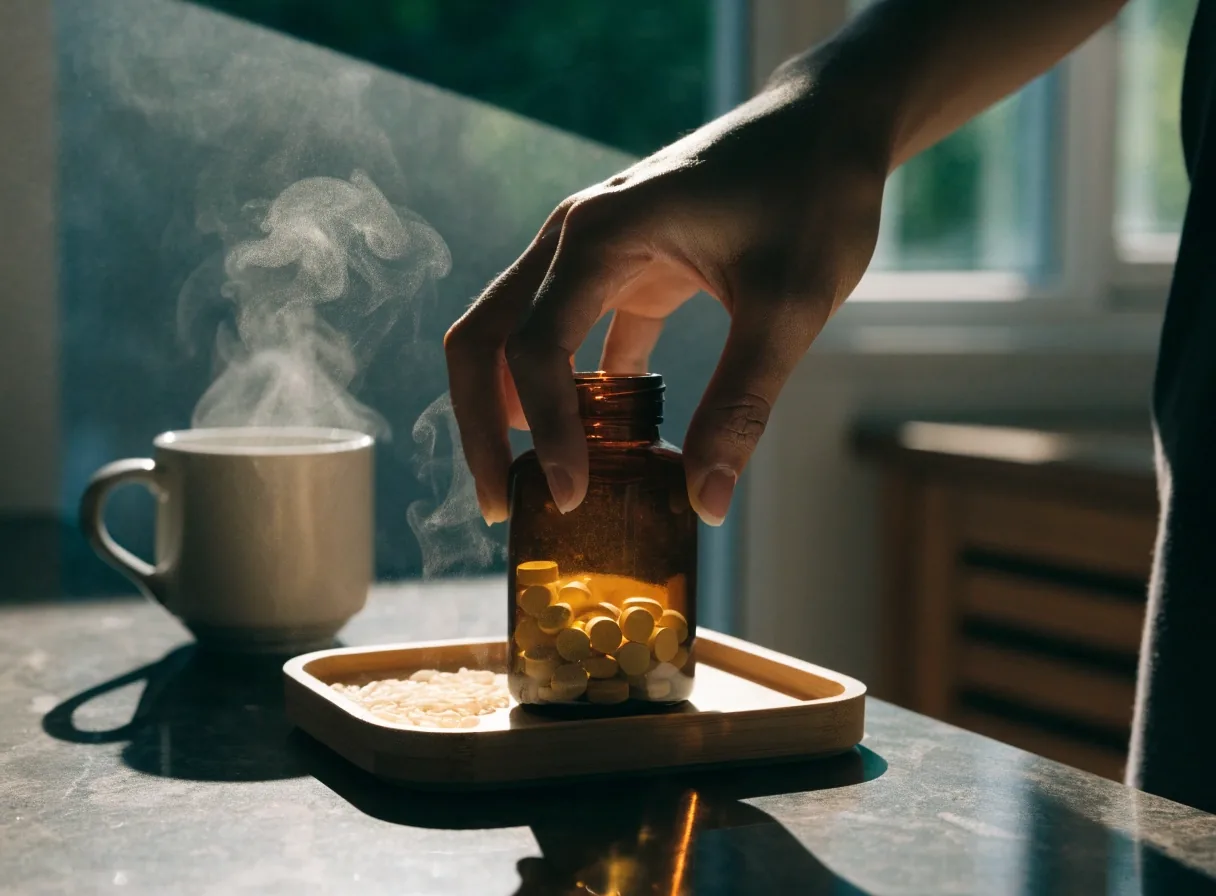
Morning anchor
The cup you already make is the cue. The bottle sits beside it, inside arm's reach.
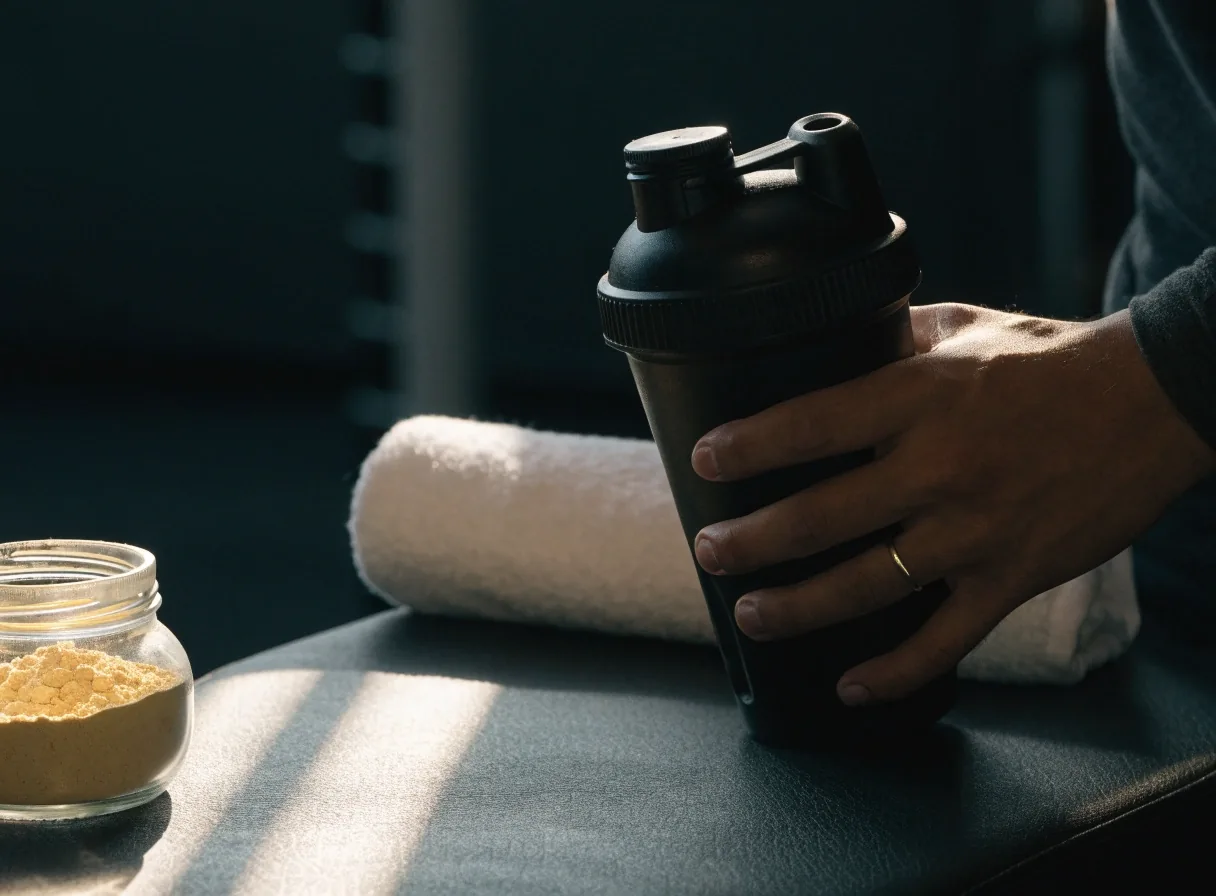
Training anchor
The shaker you already rinse becomes the second slot for a powder or an energy and endurance formula.
Reading healthy lifestyle products as a category
The phrase covers a wide shelf: daily multivitamins, botanical capsules, drink powders, and general wellness items for men. What separates a considered purchase from an impulse one is whether you can state what the product is for in one sentence.
The one-sentence test
If you cannot say what it is for, you are buying positioning.
If you can say it, the rest of the decision is a format and amount check. Daily vitamin and mineral coverage, a botanical blend, or a protein-adjacent powder each answer to a different sentence, and a product that answers to none of them usually answers to shelf appeal instead. The test takes less than a minute, and it is surprisingly effective at clearing a crowded cabinet.
Shelf categories worth naming
- Daily multivitamins
- Broad vitamin and mineral coverage for men, usually one unit per day.
- Botanical capsules
- Single-root or blended extracts, taken for a stated routine goal.
- Drink powders
- Maca and similar roots, mixed into water or milk at a set time.
- Everyday wellness items
- Supporting habits rather than formulas — sleep, movement, hydration.
What changes after the first month
Novelty fades around week three or four. That is when the routine either has a fixed slot in your day or quietly disappears. Products that survive are usually the ones with the smallest friction: one capsule instead of four, a fixed meal to attach to, a visible storage spot.
If something falls out of your week, treat it as a format problem before assuming it is a motivation problem, and adjust the setup rather than the ambition. Dropping from four units to one, or moving the bottle from a cupboard to the counter, is usually a bigger change than any new product.
The four-week checkpoint
- Did the product get its own fixed slot in the day, or is it still negotiable?
- Did you finish most of the container, or is it sitting half full?
- Would you notice if you stopped taking it — beyond the habit itself?
- Could you restate its purpose in one sentence without reading the label first?
Building a shelf you can explain
A workable routine is one you could describe to a friend in a sentence per product: daily coverage from a multivitamin, botanicals for energy positioning, a powder you actually drink.
When a shelf gets crowded, overlap becomes the real risk — two products with the same B vitamins, or two botanical blends with near-identical panels. Keep a short written list and check it before adding anything new.
See how we evaluate formulasA short shelf list, one line per product
- Men's multivitamin Broad daily coverage. One unit, with breakfast.
- Botanical blend Root-based capsules taken for a stated everyday goal.
- Maca powder Mixed into water at a set time, not squeezed between meals.
- Everything else Parked on one line with a reason, or removed at the next review.
Before adding anything
Read the new panel against your list line by line. Two products sharing the same B vitamins or near-identical botanical panels do not double the effect — they just double the units you have to take, and usually one of them stops getting used first. Comparing panels side by side is exactly the job of our formula comparison pages.
Compare men's formulasWhen to reconsider what you are taking
Review your shelf twice a year, or whenever your routine changes: a new job, a training block, a move across the city. Stop anything you cannot explain the purpose of. It is fine for a period of your life to need different products than the one you are in now.
Restock before you run out rather than after, since running out is how routines end. A two-day gap turns into a two-month gap surprisingly fast when the bottle is not on the shelf.
If you take prescription medicines or manage a health condition, raise product questions with a qualified professional rather than an editorial page. We write about formats, ingredients, and routine design; we do not assess your individual situation.
Contact the editorial team
Questions we get about routines
Three answers that come up most often when readers write in about storage, formats, and overlap.
Where should I store supplements in a humid city?
A closed drawer away from heat, sunlight, and steam. Keep the original labelled container rather than decanting into something unmarked — the amounts and the suggested-use line are the two details you actually need later.
Do capsules and tablets work differently?
The main differences are convenience and how many units a serving requires. Check amounts per serving either way, since a serving of two capsules and a serving of one capsule are not the same arithmetic when you divide the container price.
How do I avoid taking overlapping products?
Keep a short written list of what you take and compare panels before adding anything new, especially B vitamins and botanicals. If two lines describe the same job, one of them is redundant on your shelf.
Build a routine that survives the third week
Format, serving size, and storage decide more about whether a product stays in your week than any single ingredient. Pick the smallest format you will genuinely take, attach it to a moment you already have, and review the shelf twice a year.
Where to continue
- Ingredient Guide What common roots, berries, and mineral blends are usually formulated for.
- Formula Comparisons Serving counts and format differences, side by side.
- How We Evaluate Formulas The criteria we read panels against, and what we leave out.
- About Us Who writes this resource and how to reach the editorial team.
Editorial questions: [email protected] · Monday to Friday, 9:00 AM – 6:00 PM.